
Bench Warrants in Faribault County
Minnesota's public vocabulary is plain: bench warrant, warrant, or warrant for obtaining a defendant's appearance. Whatever the label, a bench warrant in Faribault County means a person missed a required court obligation. The usual trigger is a failure to appear after a summons, citation, or complaint. Rule 6.03 opens a separate route when the claim is a release-condition violation instead. Unpaid fines are a different animal. The state does not use the Texas term "capias pro fine," and money trouble alone does not create a warrant here. A payment problem turns into one only through a court date that came and went, or a court direction that went unmet. That distinction matters when you call the clerk, because it points to which obligation needs fixing and what the judge will want to see before recalling the warrant.
After a Missed Faribault County Court Date
The days right after a missed date are the easiest to fix and the easiest to misread. A calendar listing vanishes once the date passes. That tells you nothing about a warrant. Faribault County posts its daily calendar at 7 a.m. and refreshes it hourly, confidential matters are left off, and the court itself warns that an absence is not a cancellation. So do not read a blank as good news. Call Court Administration at 507-526-6273 with the case number and ask what the judge ordered. If a warrant did issue, ask which type of process it is and what the next court-directed step looks like. If it did not, ask how to get the case back on the calendar. Either way, the answer comes from the court, not from the schedule.
How a Faribault County Bench Warrant Is Issued
The judge issues the warrant, usually after the court records a missed appearance or an unmet obligation. Minnesota Rule 3.01 sets the probable-cause and response conditions that decide whether a case starts with a summons or a warrant in the first place. A summons is the preferred starting point. A warrant is reserved for a failure to respond, an inability to locate the person, or a public-safety concern. Once signed, the warrant is a court and law-enforcement matter. It stays live until the court recalls or inactivates it, or until it is served. Faribault County's public report does not show that status. The confirmation has to come from an office. When you have a case or citation number, Minnesota Court Records Online can help identify the underlying case, and a case-number search can return records that a name search leaves out.
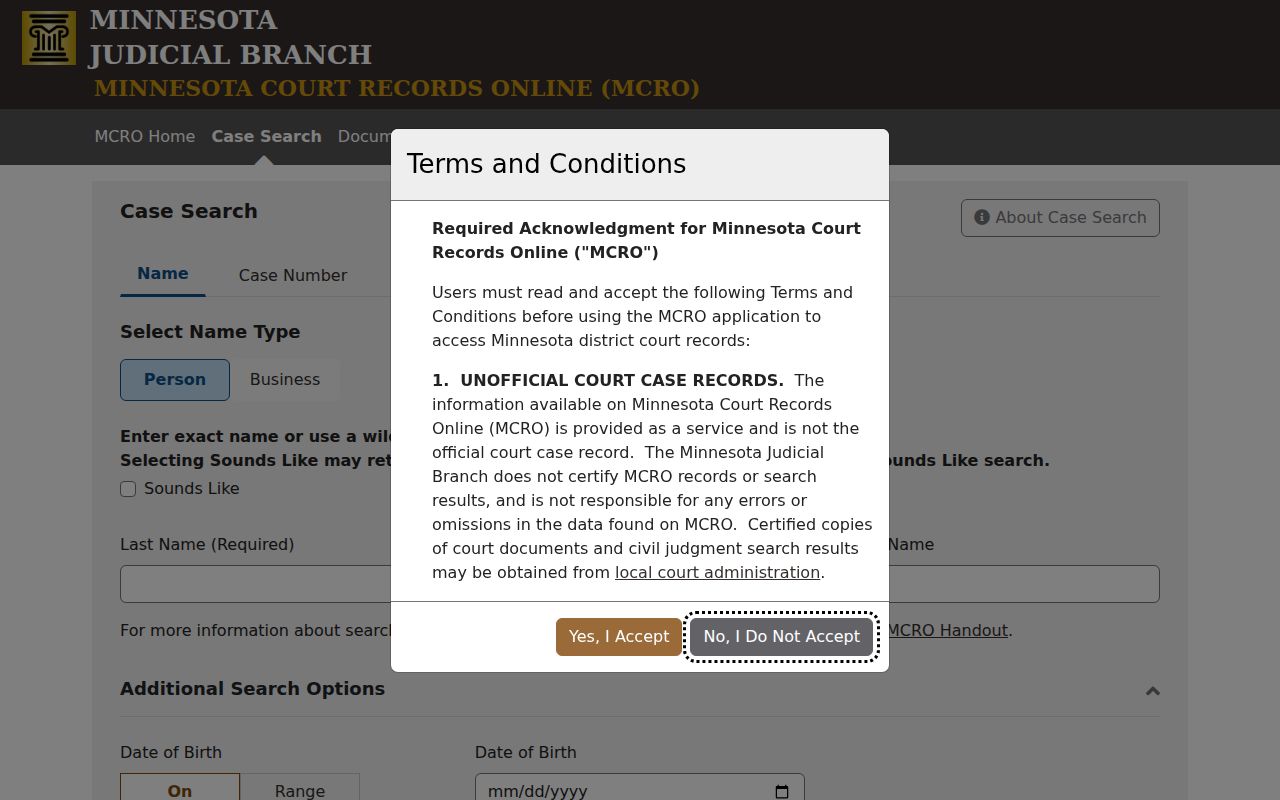
Use the case screen for context, then confirm the warrant itself with the court.
Faribault County FTA Warrant Form 8
Minnesota publishes the paperwork behind a failure-to-appear warrant. Criminal Procedure Form 8 is the application and warrant form used when a defendant fails to appear as instructed in a complaint, summons, or citation. The blanks tell the story. The form asks for the court, county, and judicial district, the plaintiff and defendant, the district court file number, the failed-appearance facts, and the charge. It also asks for the prosecutor's identification and signature plus the warrant direction to the Sheriff or another authorized person. A judge's signature and date block follow, along with a release or bail-condition section. It is a court form, nothing more. No one files it to clear a Faribault County warrant, and it is not a public filing portal. It simply shows what the judge in Faribault County had in front of them when the process issued.
Bench Warrant vs Arrest Warrant
Both instruments authorize custody, but they start in different places. A bench warrant responds to something a person failed to do in an existing Faribault County case. An arrest warrant responds to probable cause on a charged offense. That difference decides which office explains the matter and what the person needs to fix.
| Feature | Bench Warrant | Arrest Warrant |
|---|---|---|
| Trigger | Missed court date, failure to appear, or noncompliance | Probable cause on an offense |
| Who Issues It | District Court judge | District Court judge |
| Underlying Case | An existing case the person skipped | A charged offense |
| How It Clears | Appearance, recall, or a new setting | Surrender, bond, or court appearance |
| Public Report Label | Not shown; the county report has no type column | Not shown; the county report has no type column |
Faribault County Sign-and-Release Warrants
Not every failure-to-appear warrant authorizes an arrest. That myth is worth correcting first. Under Minn. Stat. 629.415, a court may issue a sign-and-release warrant in qualifying misdemeanor and gross-misdemeanor situations. The conditions are specific. The summons must have come back undeliverable, the person must have no earlier failure to appear, and the prosecutor must not show that bail is necessary. The statute says the warrant does not authorize arrest. Instead, it directs the officer to inform the person and hand over a new court date before the warrant is inactivated. Whether a Faribault County matter qualifies is a court question. Ask Court Administration and the Sheriff's Office which process sits in the file rather than assuming the worst case.
How to Resolve a Bench Warrant
Resolution starts with confirmation and ends with the issuing court. Work the steps in order. Do not skip the first one, because Faribault County publishes no walk-in surrender protocol or bond window.
- Confirm the warrant is active and identify the court that issued it.
- Ask Court Administration what the file shows and what the court expects next.
- Talk with a lawyer about an appearance, a motion to recall or quash, or a new setting.
- Resolve the underlying obligation, whether that is an appearance, a fine, or a condition the court imposed.
Caution: A bench warrant does not expire on its own, and an unresolved warrant can surface at a traffic stop or a license transaction.
Faribault County Release-Condition Warrants
A release-condition violation runs through a different state-form route. Minnesota Rule 6.03 governs warrants tied to conditions a court imposed while a case is pending, and the forms appendix carries the release-condition forms alongside the failure-to-appear form. The practical difference is the trigger. An FTA warrant answers a missed appearance. A release-condition warrant answers an alleged violation of what the court ordered. Those matters are case-specific, and the conditions themselves live in the court order. Ask Court Administration which form applies to your Faribault County file, and whether counsel needs to be involved before any contact with the court.
Which Faribault County Court Issued It
Faribault County has one court for this work. Minnesota runs a unified District Court, so no municipal or justice-of-the-peace docket keeps a separate bench warrant. Even a warrant tied to a city citation stays with the District Court that took the case. Court Administration answers questions at 507-526-6273 from the courthouse at 415 North Main Street in Blue Earth. Hours run 8:00 a.m. to 4:30 p.m. on weekdays. The Sheriff's Office cannot recall a warrant. Only the issuing court controls that. The Faribault County District Court page lists the current Court Administrator, the phone and fax numbers, and the jurisdiction notes for the county.
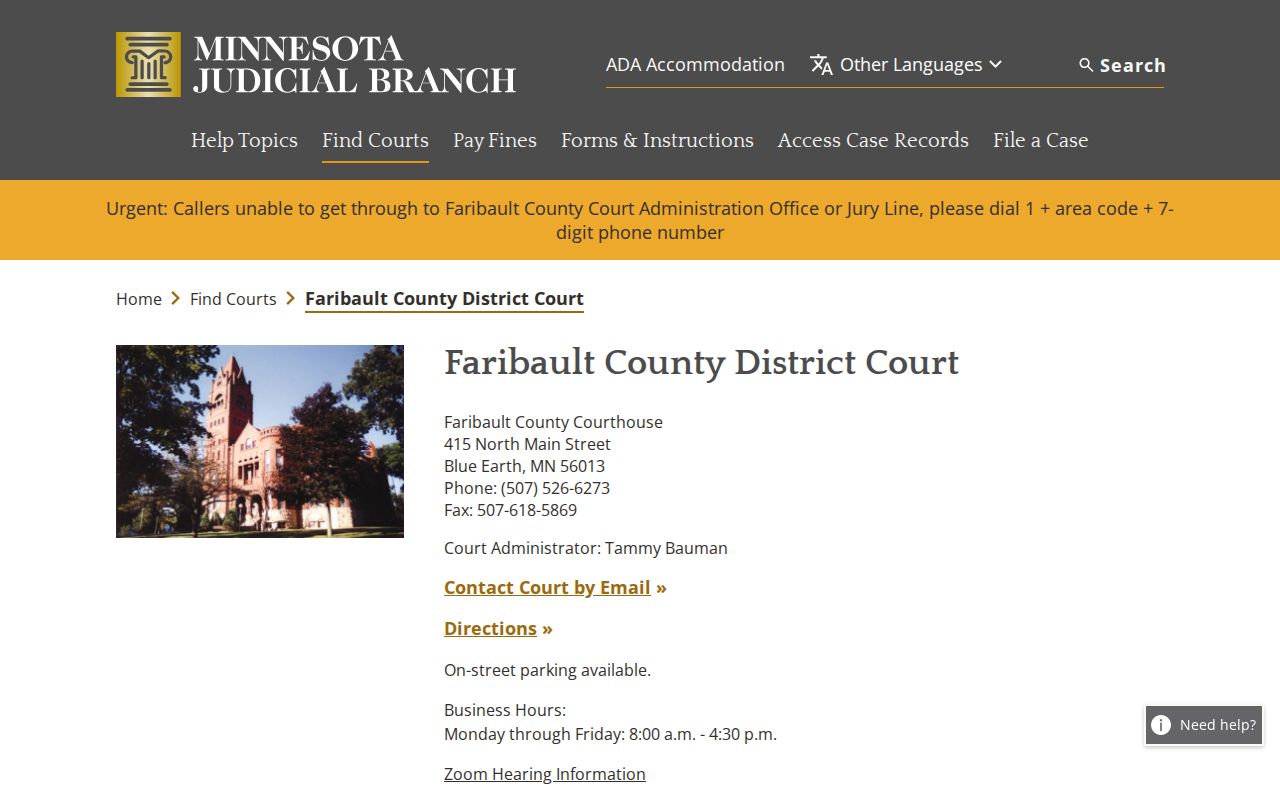
Faribault County Court Administration can tell you which judge signed the bench warrant and what the file requires to move it forward.
Minnesota Warrant Law and Faribault County
Two Minnesota statutes govern a failure to appear. Neither applies automatically. Minn. Stat. 609.49 covers intentional failure to appear by offense level. Its felony subsection adds a 48-hour voluntary-surrender window for a person who turns themselves in before being apprehended. Minn. Stat. 609.491 sets a separate 10-day beyond-control procedure for petty misdemeanors. The facts and the notice decide which rule fits. Do not assume a statutory window covers your case in Faribault County without checking. Minnesota Rule 3 governs the issuance, contents, and execution of a warrant. It also requires that the defendant be informed of the warrant and the charge.
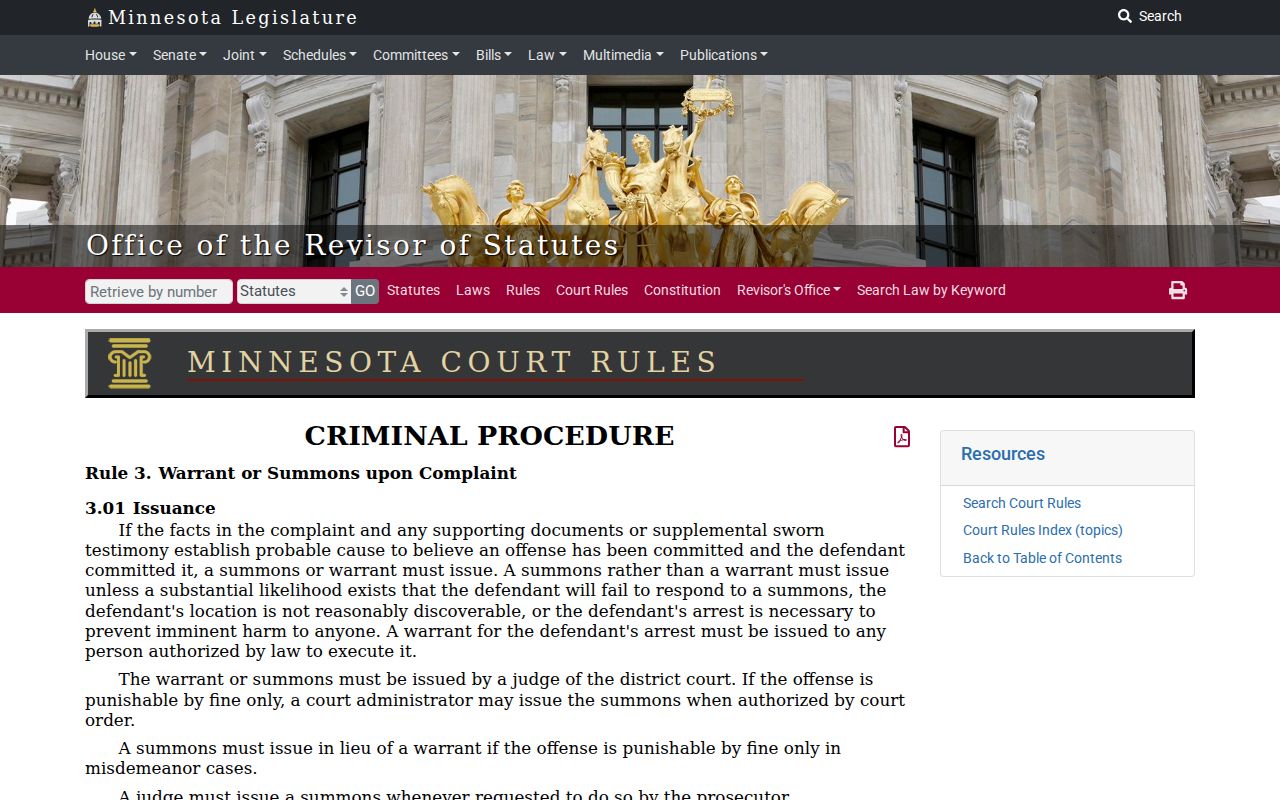
In Faribault County, that rule is the plain source for what a warrant actually authorizes. Read it before you talk with a lawyer.